


EN
中文


Search websites, locations, and people
A next-generation photonic sensor for ethanol detection developed
29, 2025
Email:
Phone:
A research team led by Prof. Pavlos Savvidis at Department of Physics; Westlake University has developed a next-generation photonic sensor for ethanol detection. Their study, titled “Smart Photonic Indicator for Ethanol Detection via Pressure‐Responsive Shape Memory Polymers” was published in the journal SmartMat on 10 July 2025. The newly developed Smart Photonic Indicator (SPI) combines shape memory polymers (SMPs) with inverse opal photonic crystal structures. Unlike traditional photonic sensors, which require constant immersion in liquid analytes, these innovatively designed SPIs can detect analytes even after evaporation. SPIs can permanently "remember" their initial shape while displaying a temporary shape through water activation (cold programming). After the evaporation of a specific concentration of ethanol in water, the SPI can return to its original optical state. The sensor’s operation is driven by the interplay between Laplace pressure generated during solvent evaporation and the elasticity of the SMPs. When exposed to water, the photonic structure collapses and loses its color. However, evaporation of ethanol-rich solutions reactivates the periodic photonic lattice, restoring vibrant structural colors. This reversible, room-temperature process makes the sensors especially suitable for portable and real-time visual ethanol detection.
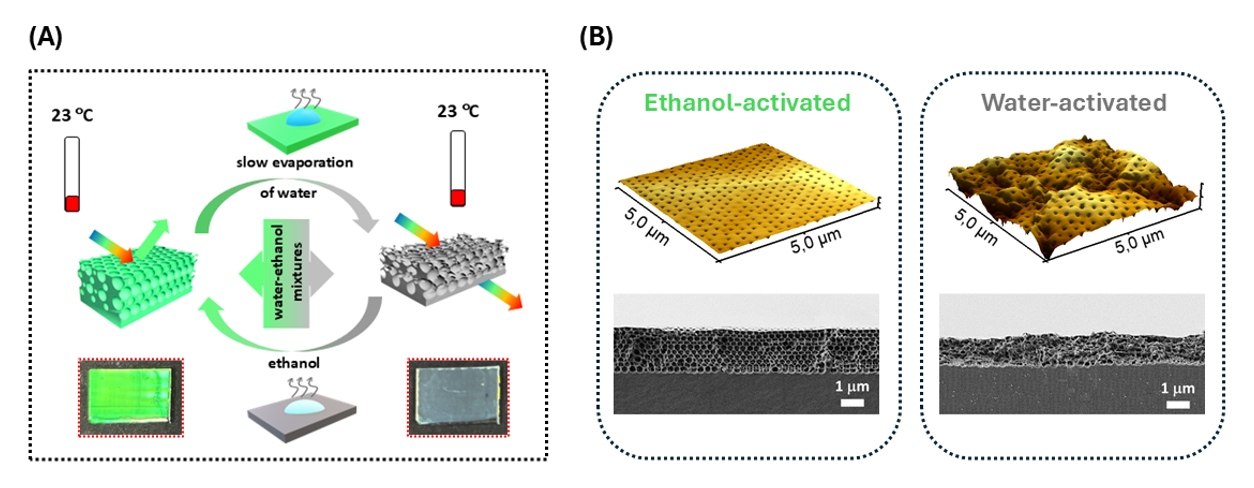
Figure 1. Illustration of the two extreme structural states of the SPI: a recovered periodic structure, which displays a bright photonic crystal color enabled by ethanol evaporation, and a water-activated, deformed structure exhibiting a transparent appearance at room temperature.
The SPI films visually and spectrally responds to increasing concentrations of ethanol in water. As the ethanol content increases, the photonic stop band (PSB) reappears and shifts to longer wavelengths, producing brighter and more saturated structural colors. These spectral changes are mapped on a color diagram and correlate with decreasing Laplace pressure, confirming that ethanol triggers structural recovery. The results demonstrate the high sensitivity and reliability of the SPI for detecting ethanol across a wide concentration range. The ethanol detection range of SPIs can be adjusted by altering the size of the macropores. SPIs with larger pores (designated as SPI-350) can detect lower ethanol concentrations, even as low as 5%. In contrast, SPIs with smaller pores (designated as SPI-280) respond only at higher concentrations, typically above 50%. The spectral shift of the PSB is correlated with Laplace pressure, allowing for controlled sensitivity. This adjustability facilitates the design of sensors specifically tailored for particular concentration ranges or applications.
Authors believe their SPI platform will pave the way for new colorimetric tools in chemical safety, inkless data recording, anticounterfeiting, and environmental monitoring. Beyond ethanol detection, the approach could be extended to design other surface-tension-driven photonic systems for real-time molecular sensing.
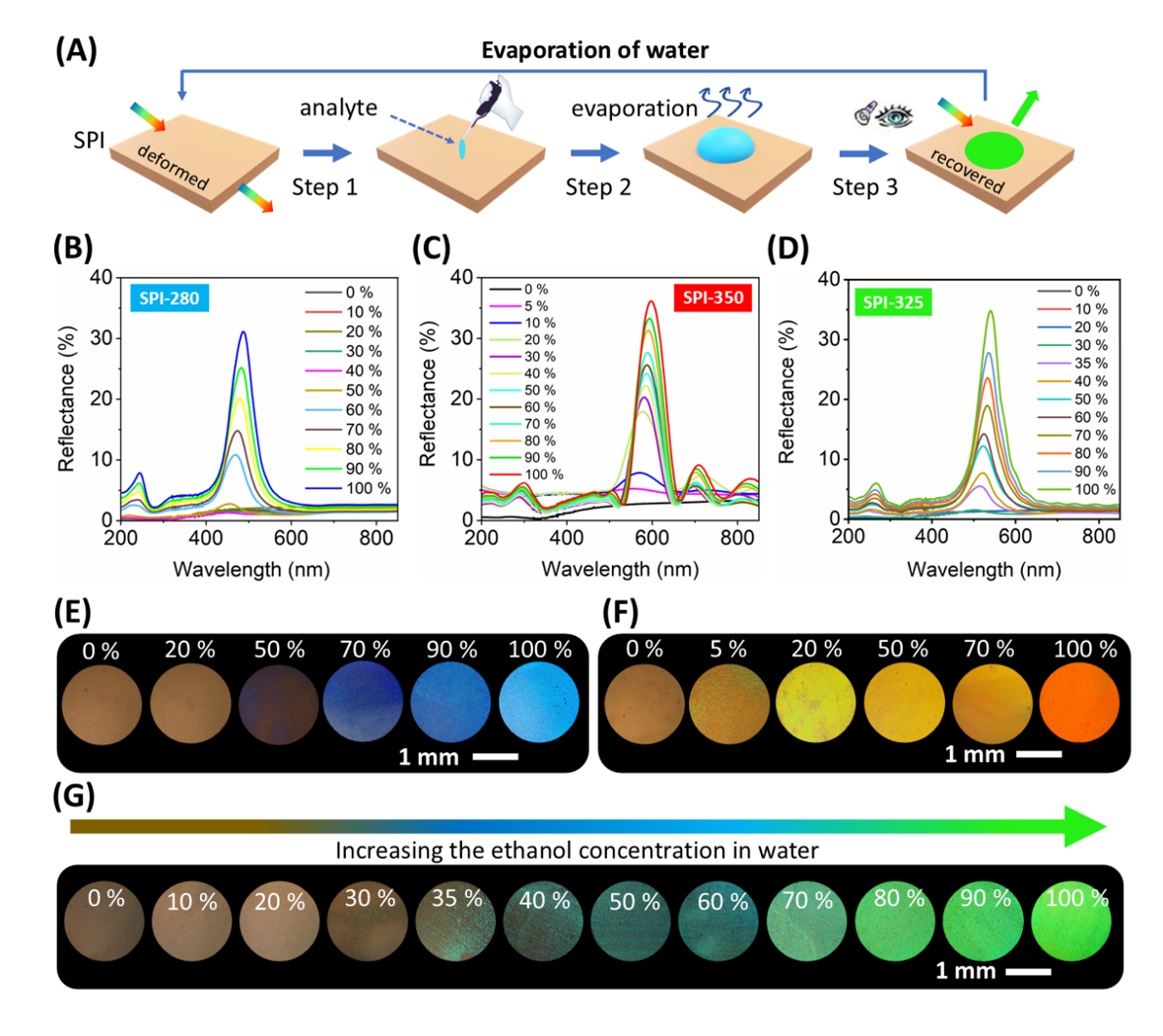
Figure 2. Optical sensing performance of SPI films for ethanol detection.
The SPI demonstrates exceptional selectivity and reversibility due to its unique reliance on liquid surface tension rather than refractive index—an approach that enables it to distinguish between chemically similar alcohols like ethanol, methanol, and isopropanol.
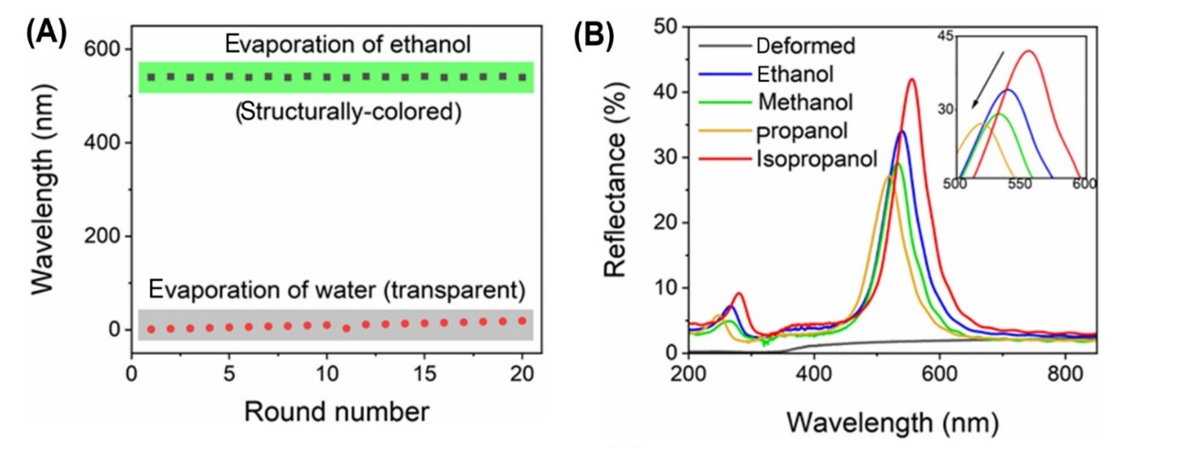
Figure 3. Reversibility and selectivity of SPI-based sensors.
“It works much like optical litmus paper for determining ethanol concentration in water. Simply touching the liquid to the smart indicator is enough to record it” said Dr. Matin Ashurov, the first author of the study.
This work was supported by the Innovation Program for Quantum Science and Technology and research foundations of China and Westlake University.
RELATED


-
STUDY WITH US
-
WORK WITH US
-
CONTACT US
-
YUNGU CAMPUS
-
No. 600 Dunyu Road, Sandun Town, Xihu District, Hangzhou, Zhejiang PR China Post code:310030 E-mail:office@westlake.edu.cn
-
-
YUNQI CAMPUS
-
No.18 Shilongshan Road Cloud Town, Xihu District, Hangzhou, Zhejiang PR China Post code:310024 E-mail:office@westlake.edu.cn
-
-
-
浙ICP备18025489号 浙公安备33010602007514号 Copyright © Westlake University. All Rights Reserved
-


If you are interested in supporting us or making a contribution, please contact:
Office of Public Affairs, Westlake University
Email: media@westlake.edu.cn
OR
Westlake Education Foundation
Email: office@wefoundation.org.cn
Phones: 0571-86886859
Fax: 0571-85271986
