


EN
中文


Search websites, locations, and people
New Quantum Monte Carlo Algorithms for Extracting Reduced Density Matrices and Calculating Entanglement Entropy in Many-Body Systems
02, 2025
Email:
Phone:
Recently, Zheng Yan’s Group (Quantum Many-Body Computation Laboratory) in the Department of Physics at Westlake University published two research papers in《Nature Communications》. The papers are titled 'Sampling Reduced Density Matrix to Extract Fine Levels of Entanglement Spectrum and Restore Entanglement Hamiltonian' and 'Bipartite Reweighting-Annealing Algorithm of Quantum Monte Carlo to Extract Large-Scale Data of Entanglement Entropy and Its Derivative'.
The first work, by combining Quantum Monte Carlo (QMC) with Exact Diagonalization (ED) methods, the research team developed a new algorithm capable of efficiently extracting the Reduced Density Matrix (RDM) and reconstructing the operator form of the Entanglement Hamiltonian. By sampling the RDM of the subsystem with very small computational cost, the algorithm can extract effective information about the entire quantum many-body system, akin to 'seeing the whole autumn from a single leaf.' This work provides a new and efficient theoretical perspective and computational tool for studying the entanglement properties of complex quantum systems.
Dr. Binbin Mao, a visiting scholar from the Quantum Many-Body Computation Laboratory at Westlake University and a researcher at the University of Health and Rehabilitation Sciences, is the first author of this work. The second and third authors are Yiming Ding, a PhD student at Westlake University, and Dr. Zhe Wang, a postdoctoral researcher at Westlake University. Dr. Shijie Hu from the Beijing Computational Science Research Center and Dr. Zheng Yan, a researcher at Westlake University, are the corresponding authors of this work.
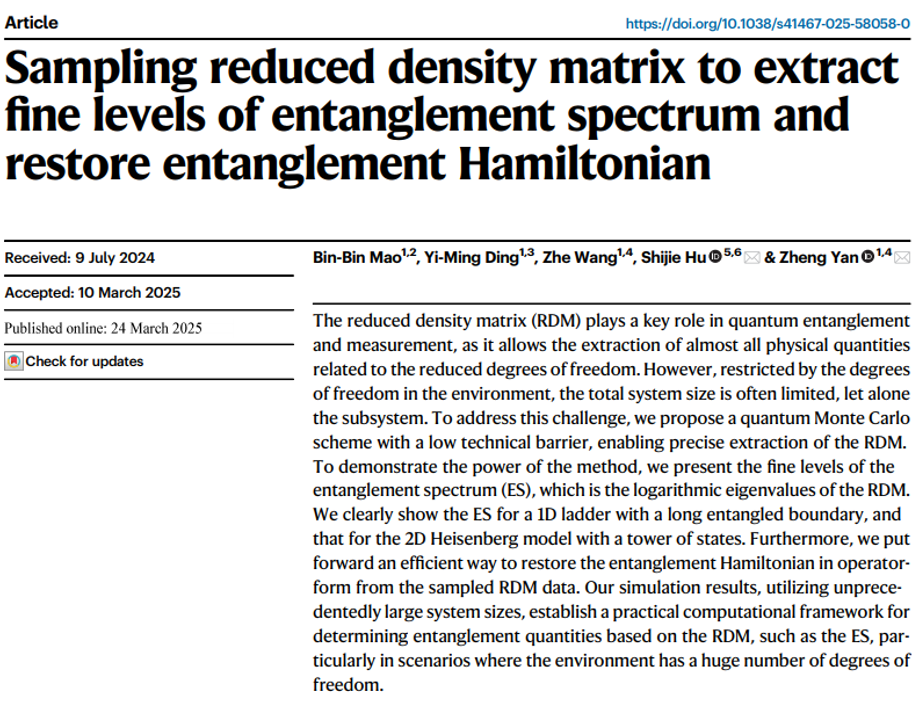
Paper Address: https://www.nature.com/articles/s41467-025-58058-0
The second work innovatively designed a bipartite reweight-annealing method within the QMC framework. This new algorithm can efficiently scan entanglement entropy in two-dimensional and higher-dimensional systems. The algorithm achieves a breakthrough in 'single computation, multiple parameter outputs,' allowing the complete scanning of a parameter space with the time cost of calculating a single parameter point using traditional methods. Additionally, the team proposed a novel scheme for directly calculating the derivative of entanglement entropy without numerical differentiation, successfully applying it to two-dimensional strongly correlated spin systems. By simultaneously analyzing the scaling behavior of entanglement entropy and its derivative, this work effectively characterizes the phases and phase transitions of quantum many-body systems.
Dr. Zhe Wang, a postdoctoral researcher at the Quantum Many-Body Computation Laboratory at Westlake University, is the first author of this work. The second and third authors are Zhiyan Wang and Yiming Ding, two PhD students at Westlake University. Dr. Binbin Mao is the fourth author. Dr. Zheng Yan, a researcher at Westlake University, is the corresponding author of this work.
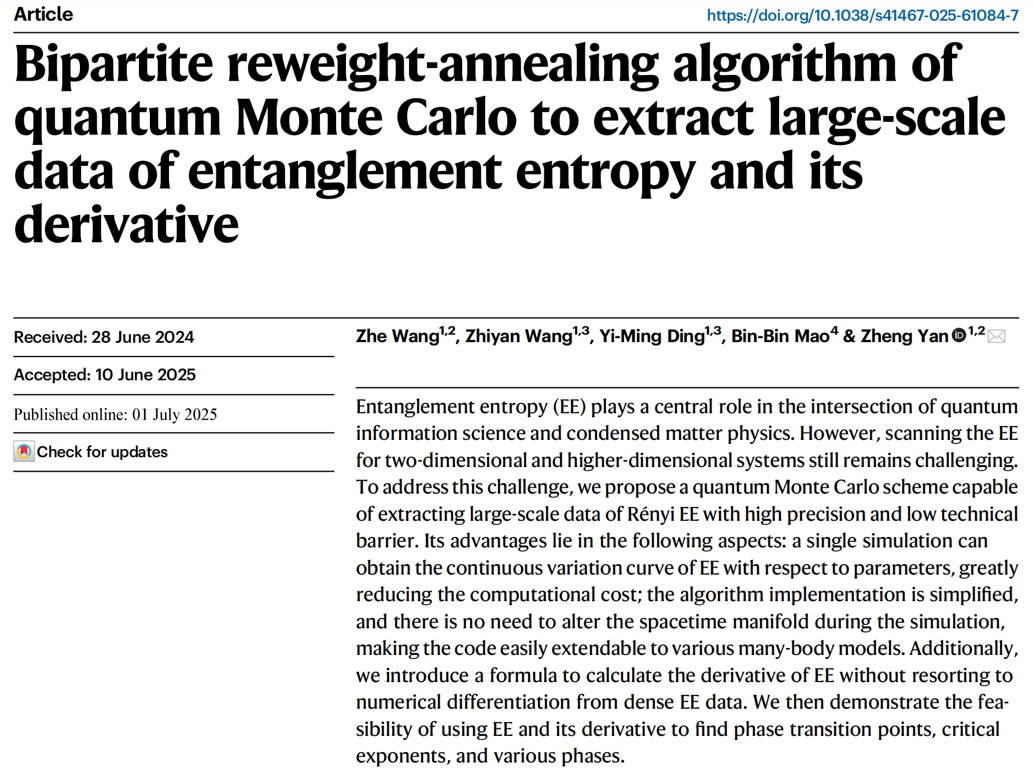
Paper Address: https://www.nature.com/articles/s41467-025-61084-7
RELATED


-
STUDY WITH US
-
WORK WITH US
-
CONTACT US
-
YUNGU CAMPUS
-
No. 600 Dunyu Road, Sandun Town, Xihu District, Hangzhou, Zhejiang PR China Post code:310030 E-mail:office@westlake.edu.cn
-
-
YUNQI CAMPUS
-
No.18 Shilongshan Road Cloud Town, Xihu District, Hangzhou, Zhejiang PR China Post code:310024 E-mail:office@westlake.edu.cn
-
-
-
浙ICP备18025489号 浙公安备33010602007514号 Copyright © Westlake University. All Rights Reserved
-


If you are interested in supporting us or making a contribution, please contact:
Office of Public Affairs, Westlake University
Email: media@westlake.edu.cn
OR
Westlake Education Foundation
Email: office@wefoundation.org.cn
Phones: 0571-86886859
Fax: 0571-85271986
