


EN
中文


Search websites, locations, and people
Groundbreaking Quantum Computing Innovation Published in Science Advances
25, 2024
Email:
Phone:
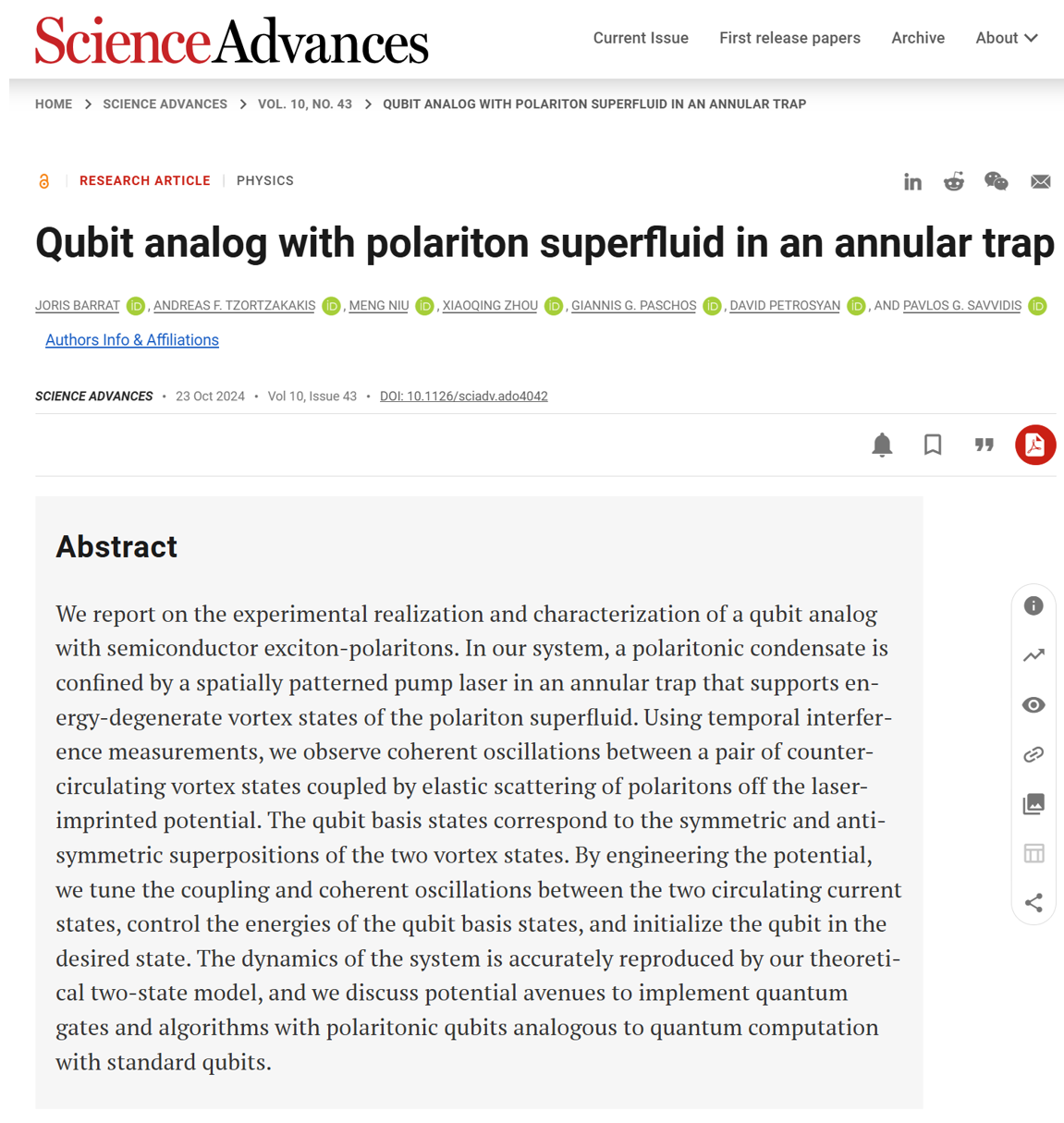
In a major advancement for quantum technology, research teams led by Prof. Pavlos Savvidis at Westlake University and David Petrosyan at the Institute of Electronic Structure and Laser (IESL), FORTH, Greece have developed a novel platform for analog quantum computation using semiconductor exciton-polaritons. This achievement, detailed in their latest publication in Science Advances, represents a significant step forward in the pursuit of practical quantum computing.
The experiment, led by PhD student Joris Barrat at Westlake University under the guidance of Prof. Pavlos Savvidis, was complemented by theoretical support spearheaded by David Petrosyan. Together, the teams created a system that confines a condensate of exciton-polaritons by a spatially patterned pump laser forming an annular trap that supports counter-circulating vortex modes. These modes form qubit states through their symmetric and antisymmetric superpositions. By carefully engineering the trapping potential, the researchers achieved precise control of the coherent dynamics of the qubit and its initialization into desired states.
The paper also explores future directions, including the potential for controllable interactions between qubits, which could lead to the implementation of quantum gates and complex quantum algorithms analogous to quantum computation with standard qubits.
“This experimental realization demonstrates the viability of exciton-polaritons as a platform for analog quantum computation, offering potential advantages in terms of operational speed and scalability,” said Prof. Pavlos Savvidis. "Our research provides a proof of concept for using these quasi-particles to perform quantum operations."
By leveraging the unique properties of semiconductor exciton-polaritons, this work presents a promising new approach to quantum computation, with broad applications across fields such as optimization and solution of hard mathematical problems and simulations for materials science.
The full study is available here.
RELATED


-
STUDY WITH US
-
WORK WITH US
-
CONTACT US
-
YUNGU CAMPUS
-
No. 600 Dunyu Road, Sandun Town, Xihu District, Hangzhou, Zhejiang PR China Post code:310030 E-mail:office@westlake.edu.cn
-
-
YUNQI CAMPUS
-
No.18 Shilongshan Road Cloud Town, Xihu District, Hangzhou, Zhejiang PR China Post code:310024 E-mail:office@westlake.edu.cn
-
-
-
浙ICP备18025489号 浙公安备33010602007514号 Copyright © Westlake University. All Rights Reserved
-


If you are interested in supporting us or making a contribution, please contact:
Office of Public Affairs, Westlake University
Email: media@westlake.edu.cn
OR
Westlake Education Foundation
Email: office@wefoundation.org.cn
Phones: 0571-86886859
Fax: 0571-85271986
